Monday, October 13, 2014

Putting Things in Places

Every time a break of some kind comes 'round (that whole once per semester reprieve we all wait for), I always tell myself that I will use this time wisely and catch myself up as much as possible. For our DH class, this would prove to be a monumental feat. My goal was to create a landing page for my website as well as the holding pages for "Research," "Courses," and "Digital Humanities." I also wanted to update my CV page to match whatever the landing page looked like and possibly figure out QGIS in order to have something on the DH page. Ambitious, I know. A bit too ambitious.

Repeat.

Thankfully, Fall Break was not a total failure. I spent over four hours creating a landing page that I think suits my needs as far as the website is concerned and looks halfway decent (I guess). I was also able to begin changing the CV page so that it didn't appear (as obviously) that they were not created at the same time or using the same mental design. The next part is where I ran into a major problem--one I haven't seemed to figure out quite yet. I realized that I have no idea how exactly to connect the pages together so that they will show up on the same site. I realize it has to do with linking directories, but I can't seem to figure out where the links are (I'm really not explaining this properly). I have everything uploaded in FileZilla (I think), but the directory path isn't really clear. 

Hours of endless frustration!

Needless to say, this is where my success stopped. I guess you could call the rest of my to-do list failures along with trying to put things (links to whatever directories) in places (the website).

Wednesday, October 8, 2014

Python Bit Me

I've been continuing my work through the Python tutorials, and two things have gotten me pretty perplexed. First, the "pushd" and "popd" thing is still bothering me even though we seemed to disregard the need for it in class last week. I can do it with the tutorial's examples, and I understand how to make a new directory and all that business, but when I attempt to do the "Now You Try" quests, I fall miserably short. Is there something I'm not completely understanding? Can I only push and pop within the same directory? That seems kind of useless when you can just use the cd command with a certain number of "../../" to get you backtracked, but that's what the tutorials seem to imply. I'm so confused.

Second, I am having trouble copying items from one directory and putting them in another. It seems like any time I need to move within two or more directories, my mind (or possibly computer) just can't handle it, and I get error messages. I really hate error messages when I know that what I'm doing should work because the example works. This reminds me of when I took Calculus in high school, and nothing ever seemed to work the way it did in the book. Grr! I'm still stuck on these two parts of Python, so any help you can offer would be useful.

Ok, that's my failure for the week. I don't know that I can call it productive, but that's what I've got to offer.

Friday, October 3, 2014

Down the Rabbit's Worm Hole

Productive failure is a concept that I am very clearly not comfortable with, and this class for me has so far been 99.8% failure. That, hypothetically, is supposed to make the successes all the sweeter, but most of the time I feel like the successes are nothing but flukes. I sometimes know why these successes happened, but that's not always the case. When it works and I know what's going on, there's another new addition that makes it seem like I am traveling through the white rabbit's hole into Wonderland. Unfortunately, there is no tea party, growing or shrinking food/drinks, talking animals, or bitchy queen trying to chop my head off.

It worked for Neo, right?

The white rabbit is quite a tricky little leporine that seduces you with promises of answers and further knowledge.  The same goes for working through programming tutorials.  They suck you in with assurances that you will understand the programming world more thoroughly and be able to apply what you learn to your own work. Well, as I go through tutorial after tutorial, I'm continuing to tumble through the rabbit hole getting glimpses of the furry little devil's bushy tail, but only that....glimpses.  I keep hoping there will eventually be an end to something, but it instead hijacks and takes me down yet another section of the hole.

I guess an example would be helpful here rather than my convoluted metaphor.  On our DH syllabus, we were to use the Google Map simple program. I had the hang of it and felt like I might actually be grasping (at straws, maybe), but then the next instruction to make it fancier throws me way off. There always seems to be such a disconnect between the two tutorials that I don't even have a solid direction anymore.

Can I use markers and watercolor too?
 
And so, I continue on with my "productive failures" while working through what the experts call simple tutorials attempting to resist the temptation to throw my computer at a wall. Perhaps one day I will catch that white rabbit and make him tell me why he's always such a jerk.

Sunday, September 14, 2014

Starting Anew: Making a Mulligan Meaningful

When it comes to academic pursuits like papers or projects, I dread the instruction to "try again" or the comment "you've missed the mark this time" because it means that I've failed. I presume that the reason I'm in graduate school is because I have been able to either avoid those types of failures (best case scenario) or to turn a failure into a productive learning experience with positive result and enjoyed the experience. As much as I loathe failing at something, I'm truly beginning to see why coding and internet projects are the result of 99% failure, 0.5% happy accidents and 0.5% logical understanding and practical application.

In my last post, I wrote an entry which was simply a screenshot of my in-progress CV, and I was pretty happy about it. That is, until I saw what others had dreamed up. I realized very quickly that the original CV page was a good attempt, but I missed the mark that time. Knowing I had missed the mark, my initial response was to avoid the problem altogether because it would maybe go away by itself (we really need to work on these little computer elves (Keebler elves who make websites rather than cookies) that actually help you in your endeavors rather than those icky trolls (not the kind that I really don't know much about, but boogeyman-wannabe ones with hair everywhere and big, gross, snotty noses that take over your computer at night when you're not looking and screw everything up) that make life more difficult). Eventually, I realized that I needed to go back to the problem and hit it head on. This led to the devastating realization that I needed to scrap the first page and try again. I needed to pull a full on mulligan.

Perhaps it's my sentimental side that prevented me from deleting my first ever attempt at writing a web page or maybe it was my refusal to highlight, delete, and reinvent the wheel, but either way I decided to keep that original code (knowing it would never see the light of Internet day). So, I opened a new tab in Notepad++ and got to work. With a particular kind of redesign in mind and a great tutor at my side, I developed something that may still not be a fantastic looking page, but it is definitely better.

Full CV here.

So that's the new and improved CV. It's probably not the best you've ever seen, and it's probably going to be changed quite a bit following this post in the coming weeks and months, but it's all mine. I'm currently going through a tutorial about Javascript, so maybe I'll be able to incorporate something cool in there (apparently, I've got high hopes tonight) with my new found Java knowledge.I guess the sky (and my productive failing) is the limit.

What has this taught me?

This experience continues to teach me that 1. There are no helpful little elves that will do this stuff for me 2. I really shouldn't avoid completing something just because it's infuriatingly frustrating (I probably won't listen to that advice but it's there to annoy me) and 3. Productive failure is a great concept, but when you are experiencing it, the "productive" aspect gets tossed out the window while the "failure" part sticks to your mental insides like fresh Double Bubble gum stuck in your hair.

So much failure.
Well, that's where I am. The highs are super high (like when something cool works and you actually know why), but the lows are SUPER DUPER low. Essentially, learning coding simulates having bipolar disorder and the only relief...well..I don't think there is any. I continue to be nervously excited to see where this DH class takes me, and this blog, I think, will be my outlet. Back to the grindstone.

P.S. Be cautious of any software you're downloading, even from trusted websites! I recently downloaded FileZilla and with it came Astromenda, a piece of hijacking malware that likes to create operational problems on your computer. Who creates this crap? Must be those trolls I was telling you about earlier!

Friday, September 5, 2014

The Digital CV

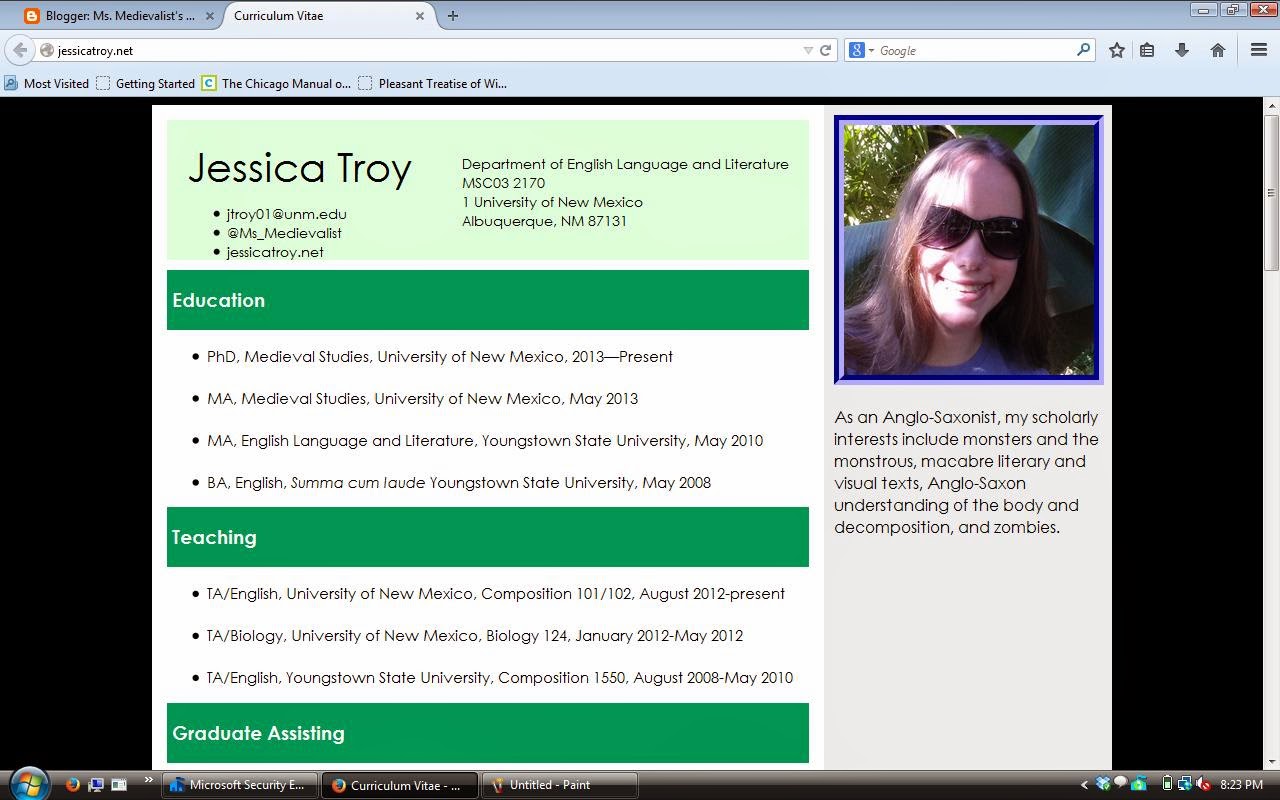
The instruction to create a digital CV was definitely a bit overwhelming and gave me the heebie-jeebies, but I decided not to panic. I'm glad I didn't. Although it definitely looks amateur and I can't really figure out how to move things or why the first line of each bulleted list is smaller than the rest, I'm happy to show off my work:

And now you know what my computer screen looks like!

I can honestly say that I'm pretty proud of this amateur mess of a web page! After screaming at my computer and trying to figure out why something worked on the tutorial screen but wouldn't on my server, I finally got it to look relatively useable. Woot for progress!

And now when Blogger's "Compose" tab doesn't do what I want it to, I can go into the HTML and figure out what needs to be changed. Woot for more progress!

Tuesday, September 2, 2014

HTM-Hell

When I received Dr. Gibbs' email this past Saturday, I immediately started panicking. His directions of "by Wednesday that you'll be able to have installed a web server on your computer according to the instructions linked to on the syllabus. ideally, you'll be able to create an extremely simple html page on your own and see it rendered in your browser to make sure everything is working" were far more terrifying than I'm sure he expected/intended them to be, or maybe not (ponderings for another day). Anyway, once I convinced myself there were no satisfactorily good reasons to hit the "drop class" button, I went about following the directions. It was as if the programming gods sensed a hint of confidence in me and went about their sabotage.

I tried to download the WAMP server and hit problems from the beginning. I uninstalled/reinstalled twice before deciding to turn to Google. I realized that I needed to update the Visual C++ Redistributable on my computer before I could actually go further with the server. I was hoping this would solve the problem, so I reinstalled again. Know what happened? Yep, I got another error message! I have a feeling that I will be seeing a lot of those in the coming months.

Turning to social media, I was able to vent my frustration on Facebook (sometimes you just need more than 140 characters). Thankfully, my level-headed friends who didn't want to, at that point, ignite their computers provided me with some troubleshooting techniques. The simple fix: I didn't update the Visual C++ thing enough. After another round of updating/downloading/praying, I finally got everything to load successfully. However, WAMP was still not cooperating. Does this count as productive failure?

I got really tired of seeing this.
 
Time works in mysterious, glorious ways.

After a few hours' break, I returned to the scene of the programming crime and was astonished to find that WAMP did download successfully and was ready to operate. How did it happen? I have no idea. I'm just glad it did. Now, on to the html stuff. It's truly amazing what an at-home crash course in programming can do. Google is helpful, and I've discovered W3 Schools Online Tutorials in the process. It took about 4 hours, but I finally have a very basic html page to call my own! There was definitely a high that came from figuring out how a bunch of tags and symbols and random words work together to actually create something. I introduced myself to the world. Do I feel super confident now that I've made this first step? Not really. Am I ready to use this information and keep going with it? Of course, but that also scares me quite a bit. I'm glad to be in a class with individuals possessing a vast array of experience levels who are more than willing to share resources and commiserate with triumphs and failures.

Wednesday, August 27, 2014

Am I a Senior?

I must admit that reading through Anne Burdick, et al.'s Digital_Humanities was an intimidating (and at times dull) endeavor. I know that I must understand the basic principles and theories of DH in order to better embrace this as a scholastic enterprise, so I have been trudging through the book like a good little scholar. Chapter 2 is all about methods and genres, but reading through them didn't really make a complete picture of what exactly DH does. Thankfully, they put case studies at the end of it. I assumed that these case studies would help me visualize the products of the methodologies (one would assume that illustrating visualization techniques in a book about DH would prove useful). However, I found something a bit different.

Throughout the book, and as a fellow reader describes in detail, the authors seem to consistently put the "analog" side of things in the trash heap. I'm not fully surprised by this, but I was a bit shocked at how they, in text, dealt with those scholars who are unaccustomed to the digital side.  In the "Methods" section of case study 2, they acknowledge the "senior scholar" (implications for senior can be wildly speculated upon) and specifically state that he "has asked that his interpretations be given a separate layer for presentation online so that his work can stand alone and be scraped off for later publication in print format." After having just discussed that this project will need to include crowd-sourcing and the establishment of partnerships to get the work done, this statement seems to put the scholar who isn't completely enraptured by DH in the "other" category. They continue in the "Dissemination and participation" section to ostracize the "senior scholar" by stating, "The bridging of traditional and new modes of scholarly engagement through distributed knowledge production approaches will allow the senior scholar to work effectively with younger scholars and allow for crows-sourced input without collocation." All in all, this doesn't sound very positive for the senior. 

Perhaps I am equating senior with the negative connotations associated with growing old and, seemingly, out of touch with the digital world.  Being a senior citizen or having a senior dog, for instance, doesn't tend to be the most glamorous or sexy thing out there--is that what the authors are going for? Or maybe, in an effort to respect the scholar's experience and time in the field, the authors called him "senior". This is entirely possible. Regardless, there doesn't seem to be much positive press being thrown around for the guy who wants his work set aside and "scraped off" (again, not the sexiest of terms to be used) for print publication.

Then it hit me.

I think I might be akin to the "senior scholar"! Don't get me wrong, I am not comparing myself to him because of my overall expertise and earned merit in the field. I am far from that. However, I do tend to take the "let's get it in print before the digital" route (I'm not even a fan of only owning digital books, movies, or music). I don't feel that DH projects have less worth--quite the opposite, especially after reading about the amount of work put into these projects--but I would definitely rather have my own work in print versus digital-only. It would be awesome to have both, but I will always choose print over digital if given the choice. I'm also pretty confident that I will not join the "generation now cursed with the label 'digital natives'" who "will surely develop the capacity to become comprehensive digital humanists" because that statement alone scares the hell out of me. I like collaboration in the sense that everyone does their part. However, the authors point out another place that seems to send me back into the senior pile: traditional concepts of authorship in the humanities being challenged by DH projects and team effort. Will these projects be worth the same amount as a project done alone in a "traditional" medium? I guess I'm fixated on the "single-authored achievements".

 Does that make me the senior? In the estimation of the authors, does that mean I'm ready for the analog scrap heap? I'm going to stay positive and assert that both print and DH forms of projects can, should, and will be embraced so that no one and nothing has to go on the scrap heap. Also, because I'm a novice in the DH world, I will look forward to learning rather than feeling less-than because I've not fully engulfed myself in DH.  We've all got to start somewhere.